Reducing friction in high-data onboarding for scholarships
A scholarship matchmaking app:
Designing a high-trust onboarding flow to verify student identities and unlock financial opportunities in low-bandwidth environments.
August 2020
-
Project goal
The objective of this project was to create a platform that is easily accessible for less privileged communities in SA, and serve them with educational, job, internship opportunities that are not only relevant to their skills and qualifications, but also immediately in reach.
-
Client and project type
The project execution was a Progressive Web App. Foonda is a startup founded by a Local entrepreneur in the Financial sector. The project was fulfilled through a small tech company, who consulted me directly to lead the UX and UI.
-
My role and responsibilities
Research, user flows & stories, sketching, wireframing, visual design and prototypes. As an independent UX consultant, I worked closely with the tech and implementation team at the tech company. They developed the business case, and rough business requirements from which I had to solve for on the app.


Project Summary
How might we match users with opportunities that appeals to them and fits their skill and qualifications profile, in order to empower talent from different backgrounds, streamline the application process with faster better onboarding, and increase the educational equality in South Africa.
The result would be a ‘feed’ of relevant, and already matched opportunities shown to the user, whereby they can apply with easy ‘one-click’.
In essence, the app aims to make the journey of economic upliftment through education a more immediately viable choice for underprivileged learners.
The Challenge
South African Education Challenges
8% - the percentage of South Africans that speak english at home, school or work
6th place - English only landed #6 most common second language in SA
55% - Percentage of matriculants under 24 years of age without a job
South Africa has an overwhelming supply of young talented people.
Unfortunately still today, there’s a barrier to access tertiary education and opportunities for lots of communities. Wealth and access to technology isn’t the only barrier.
Onboarding challenge:
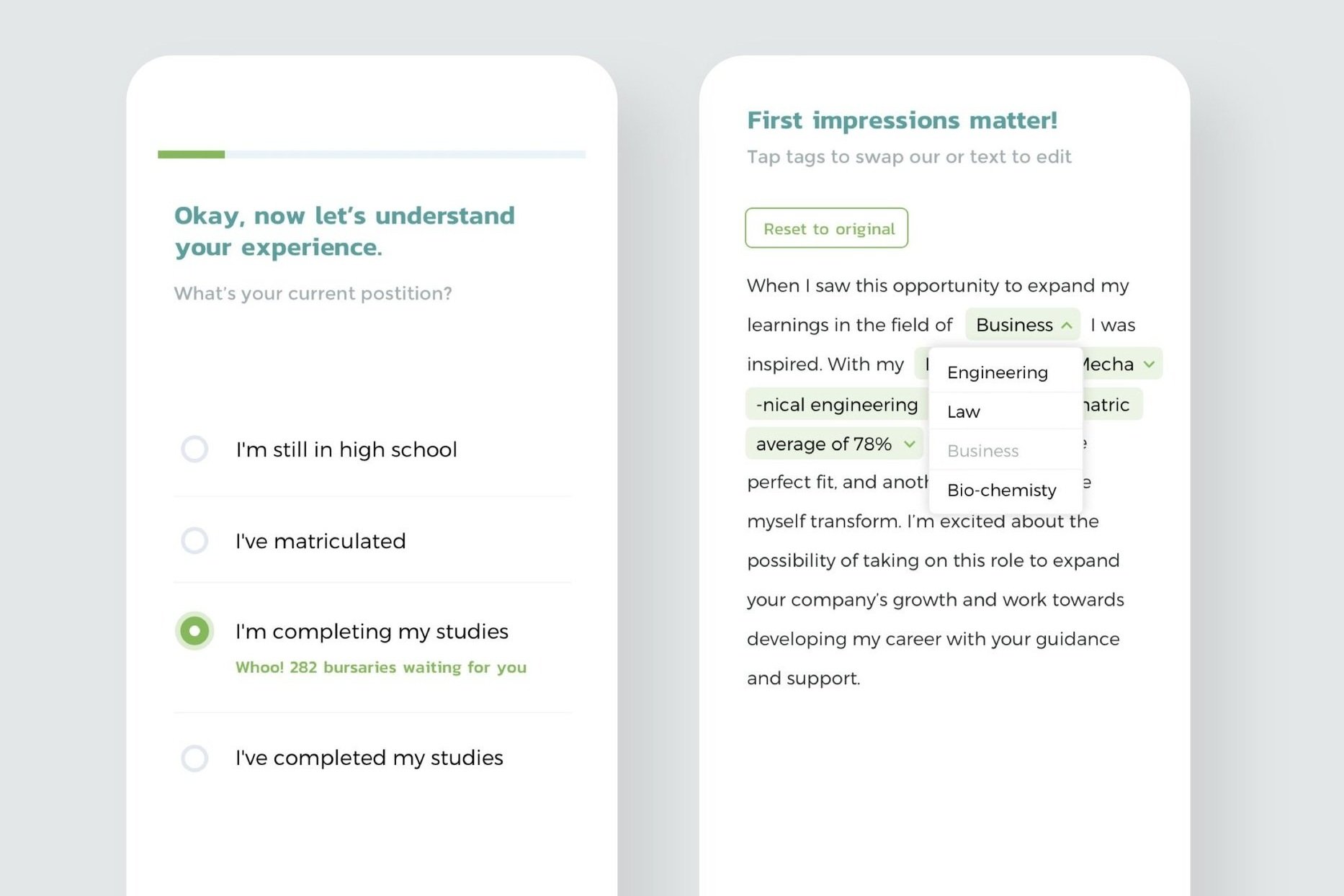
The biggest challenge and our biggest success determinator. During onboarding, we want to capture all information that’s usually required in a scholarship/internship application. This includes personal information, documentation and any educational qualifications and experience to date. A very tedious process. If we succeeded, the rest of the application process would be almost ‘automatic’.
Trust becomes more crucial when asking personal information so early on in the user journey. The design challenge was establishing enough trust and perceived value upfront to prevent drop-off during this 'heavy' data capture phase
Budget challenge:
Budget is always a constraint. Foonda is a startup, and can’t afford fully custom built tech intelligence. Most of the features had to be executed in ‘out-of-the-box’ solutions to get tech MVP out. This required a lot of collaboration between me and the solutions architect, to define the features and their behaviour on the front end.
Technical challenge:
We chose a PWA not just for budget, but for Financial Inclusion. Our target demographic often relied on older devices with limited storage or expensive data plans. A PWA allowed us to offer a 'download-light' experience, ensuring access for users in emerging markets.

Methodologies used
Competitor analysis
Technical Assessment
User flows
Persona exploration
Wireframing
Prototyping
UI design
Development collaboration
The Process
Competitor analysis
Doing research for this project, there we very few competitors. For this reason, I researched rather for apps that simulate the same experience and emotional journey.
Persona exploration
In South Africa, the population all graduate or matriculate at different times in their life. For me, it was then more important to understand their base commonalities to segment them.
User flows
I utilized Progressive Disclosure to break the heavy KYC requirements into bite-sized steps. By celebrating small wins (e.g., 'Profile 50% Complete!'), we used the Goal Gradient Effect to encourage users to finish the document upload.
Prototyping
Once I had wireframes out, I prototyped each and every flow with the aim to
Identify gaps and negative flows
Test positive flows with stakeholders and few users
Success and results
Publications and mentions:
Featured in 9 Publications including Mail&Guardian, 702 radio, SABC news, and Ventureburn.com
Funding
Recently received R2.1 million in funding from the Diageo Empowerment Fund
Awards
Foonda app made it on the top two in the 2019 Diageo Social Tech Startup Challenge.
Conclusion
Taking a user centred approach really pays off. Taking time to understand the emotions the user will experience, and where the opportunities lie for the app to serve and help them. Foonda is one of the first of it’s kind on the market and attempting a draughting but reward task. It’s not perfect, and like the ever changing landscape in South African educational up skilling, the app and will need to evolve.
My learnings:
I found inspiration in unexpected places. Something this taught me, is to look at references and products that can have the same emotional journey, rather than looking at our own competitors in the same industry. This means that research starts before the project, with my daily engaging in any products in my surroundings.